Skip to content

History of the Gaia

From the cargo clipper Zeeland of 1910 to a sailing passenger ship: what she carried, where she sailed and what life on board was like.

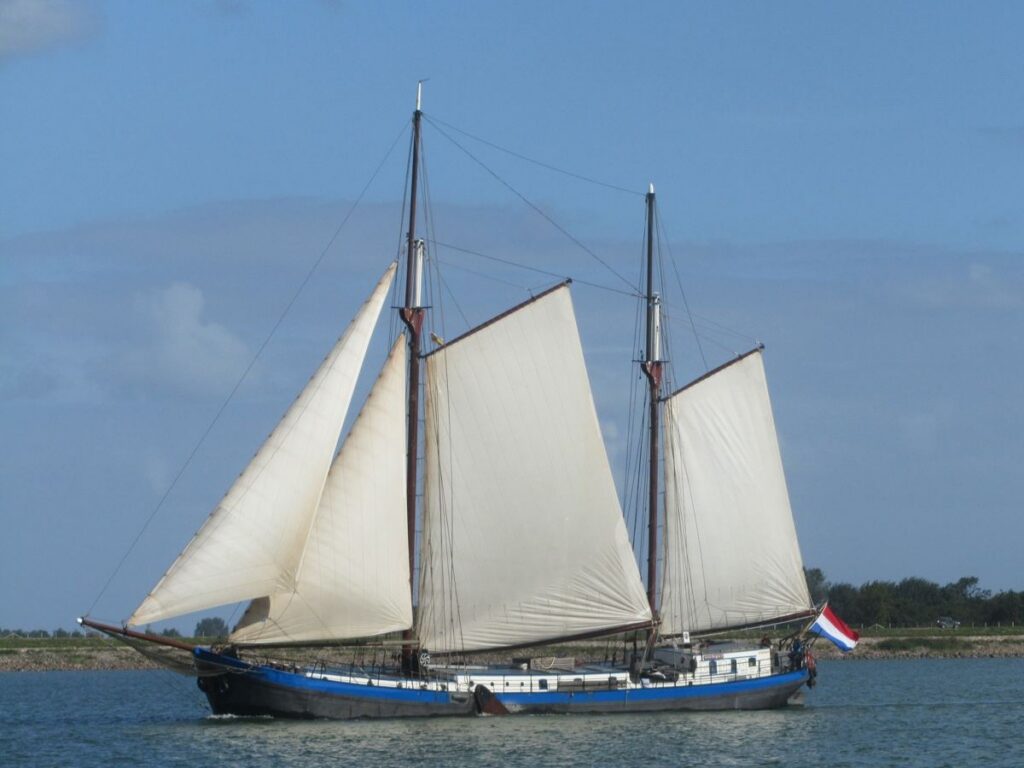
Tweemastklipper Gaia onder vol zeil op het IJsselmeer

1910: built as the cargo clipper Zeeland

The Gaia was built in 1910 at the Van Zuilekom shipyard in Raamsdonksveer, as a steel river clipper for carrying cargo on the Dutch inland waterways. She was called Zeeland. On 24 August 1910 the ship was measured for the first time in Dordrecht, under measurement number 2357.

A clipper like the Zeeland sailed on the wind. With a fair wind she covered long distances. With a headwind or no wind at all, the crew waited, poled with long quants, had the ship towed from the towpath by a horse or by people, or took a tow.

Gravel, sugar beet and grain

In her early years the Zeeland mainly carried gravel, sugar beet and grain on the rivers of the southern Netherlands.

  • Sugar beet was seasonal work. Around 1900 independent inland shipping had grown with the campaign trade: carrying beet and potatoes to the factories in the region. The campaign started in October. The sugar factory in Bergen op Zoom received most of its supplies by water; as early as 1884 it had a conveyor belt for unloading boats, and from 1920 cranes lifted the beet straight out of the hold. The sugar factory in Sas van Gent also lay right on the Ghent–Terneuzen canal.
  • Grain went to merchants, warehouses and mills. It had to stay dry, so the hatches over the hold were closed with great care.
  • Gravel was needed for building and road works. In the twentieth century it was dredged in large quantities from the river Maas.

Living on board

The ship was home, workplace and livelihood at the same time. The skipper’s family lived in the small cabin aft, and the hold was for the cargo. Children helped out and learned the trade. The Compulsory Education Act of 1901 did not apply to skippers’ children; they only went to school if the ship stayed in one place for more than 48 hours. In 1915 the first boarding school for skippers’ children opened in Vreeswijk. After that, more and more of them went to school ashore during the week and came on board in the holidays.

1932: Henja, and hard times

On 21 March 1932 the ship was remeasured in Amsterdam, under number 7775. By then she was called Henja, and before that she had sailed as Quo Vadis.

These were hard years for independent skippers. Lorries took over more and more transport, and a report from 1936 described a trade living ‘on the edge of pauperism’. The Fair Freight Distribution Act of 1933 introduced the turn system: a skipper registered as empty at the skippers’ exchange and was given cargoes in order of registration, at fixed rates.

Seven names

In over a century the ship has sailed under seven names: Zeeland, Quo Vadis, Henja, Coen Sr., Jabe, Gyak and Gaia. A historical ship register, quoted by ship expert Pieter Klein, names the owner for three of them: De Regt (Zeeland), Kluijtenaar (Quo Vadis) and Gerrits (Henja). When a cargo ship was sold it often got a new name, sometimes after the skipper, his wife or his children.

  • 1956: remeasured in Duisburg, the large German inland port on the Rhine
  • 10 September 1957: remeasured in Groningen as Jabe, with Coen Sr. and Henja as earlier names
  • 1972: remeasured in Groningen as Gyak

Lengthened and shortened again

During her cargo years the ship was lengthened so she could carry more. Later she was shortened again. You can still see it: in the middle of the hull there is a welded joint with a different frame spacing, and the line of the bottom has a kink there, while the line above the water runs on smoothly.

Houseboat in Amsterdam

When small cargo ships could no longer compete with large motor ships and lorries, the Gyak became a houseboat. She lay in Amsterdam and, after 1980, for some time near the Hollandse Brug. It is precisely because old cargo ships stayed in use as houseboats that many escaped the scrapyard.

1986: remeasured

On 15 July 1986 the ship was remeasured in Amsterdam, under number 2881. In September 1987 she appears as Gyak in a list of historic ships, with 1910 as the year of build, the Van Suilkom yard in Raamsdonksveer and a length of 34.15 metres.

1990: charter ship

In June 1990 the ship entered service as a charter ship. Her owners at the time were Bert and Saskia Hasselt. The old hold had been fitted out with cabins and a saloon, and she had a full rig again.

1994: the Gaia

On 25 April 1994 the ship was registered in Rotterdam as Gaia, under measurement certificate HN 4331. The hull is 34.15 metres long and 6.10 metres wide. Beneath the cabins, saloon and galley lies the steel hull from 1910.

Since 2007: skipper Rob

Rob sailed on the Gaia as a deckhand for four seasons from 2003 and bought the ship at the start of the 2007 season. Since then he has sailed with groups on the IJsselmeer, the Markermeer and the Wadden Sea as owner and skipper. On deck the crew still works with halyards, sheets and leeboards, just as in 1910.

Plan your trip on the Gaia

Tell us how many people are coming and when. Rob and Sarah are happy to help with the route and the options.